
Column

Feb 3, 2026
ZEBBRA Surface Defect Inspection System
About ZEBBRA Surface Defect Inspection System
By utilizing a unique slit-light optical system and a proprietary detection algorithm, ZEBBRA makes it possible to inspect defects on vehicle painted surfaces and other objects that were previously difficult to detect without visual inspection.
Features
Point 1: Adept at 3D Objects
Deep optical depth of field.
Point 2: Strong on Curved Surfaces
Algorithm that captures diffused light and phase changes
Point 3: Close to Visual Inspection
With optimal human sensitivity and optical resolution, sensitivity can be adjusted and variations reduced by fine-tuning the slit.
Point 4: User-Friendly
Software customization possible to match specific products.
Point 5: Stable speed
Achieves high-speed and stable processing through unique technology.
Comparison of Visual Inspection vs. ZEBBRA
Advantages
| Visual Inspection | ZEBBRA | |
|---|---|---|
| Curved Surface Support | Supported | Supported by diffused light and proprietary algorithm |
| Inspection Method | Fluorescent light from various angles | Adjustable slit shift, angle, and width |
| Judgment Method | Classification → Size determination | AI classification → Rule-based size determination |
| Resolution | Approx. 300μm | 140 μm |
| Curved Surface Support | Sensitivity varies due to experience, physical condition, mood, and fatigue | Quantitative |
| Speed | Varies by person | Stable (0.75 sec/Shot) |
Application Examples
ndulating Surface Inspection
Surface Inspection for Plates, Films, Sheets, etc.
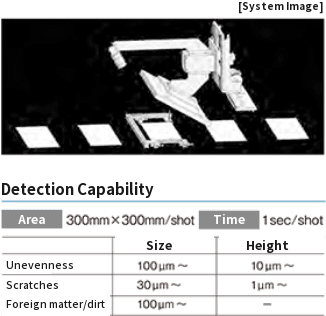
Overview
- Flexible design response is possible regardless of workpiece size or shape, tailored to the inspection target.
- Supports simultaneous inspection of front and back surfaces.
- Supports various line configurations, from offline inspection to in-line 100% inspection.
Application Examples
- Uneven metal surfaces
- Wrinkle-prone pouch film
- Deformable flexible printed circuit boards, etc
Future Prospects
TAKANO AI
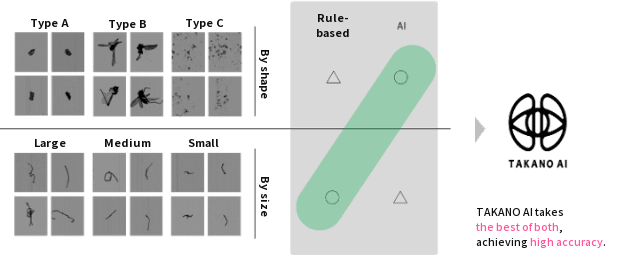
One of ZEBBRA's features is its ability to perform real-time defect classification using our internally developed AI.
As a future prospect, we will further evolve its functions so that it can be applied to other fields, such as lenses and films, not limited to current painted products.
Summary
Our unique optical system that utilizes slit light and our proprietary detection algorithm has made it possible to achieve "detection power" and "versatility," which were previously in a trade-off relationship, in a single optical unit.
In addition, inspection is possible regardless of the shape of the object being inspected.